
Virtual Assistant vs. Freelancer vs. In-House Hire: Which Is Right for Your Business?
When your workload is growing and you need help, you have three realistic options: hire a full-time employee, bring on a freelancer, or work with a virtual assistant. Each model has a genuinely different cost structure, risk profile, and day-to-day reality. Here's how they actually compare.
The full-time hire
A full-time employee costs more than their salary. Payroll taxes, benefits, equipment, office space (or the management overhead of remote onboarding), and employer-side compliance add 20–40% on top of base pay. For a $50,000/year admin role, the real cost is closer to $60,000–$70,000. You also absorb the risk — a bad hire costs months of salary plus recruiting fees to replace.
The upside: full commitment, deep integration into your team, and someone who grows with the business. For roles that require constant real-time collaboration, institutional knowledge, or represent a core function — it often makes sense.
The freelancer
Freelancers are project- or task-based. You pay only for what you need, usually hourly or per deliverable, with no overhead. The trade-off is availability: a freelancer is serving multiple clients, and their capacity, consistency, and response time can vary. For well-defined, bounded projects — a website build, a market research report, a content batch — freelancers are often the most cost-effective option.
The challenge is ongoing operational work. Freelancers are optimized for discrete projects, not for handling your inbox at 8am every day or running lead generation campaigns on a rolling basis.
The virtual assistant
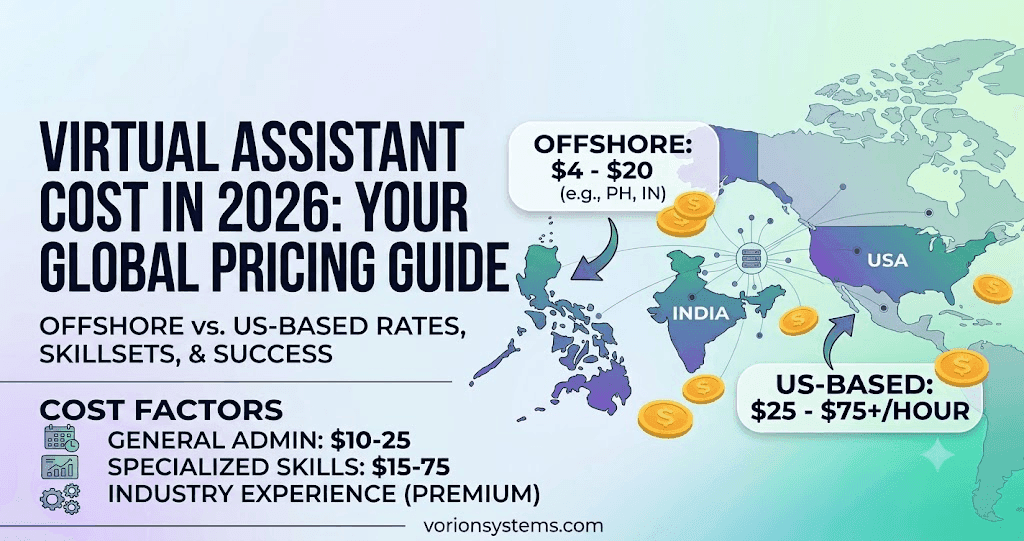
A VA sits between the two. You get consistent, dedicated support — the same person or team learning your processes — without the payroll overhead of a full-time hire. VAs typically work on retainer (a set number of hours per week or month), which gives you predictable cost and consistent availability, closer to an employee model, at 30–60% of the total cost.
For ongoing operational work — admin support, lead generation, social media, research, data entry — VAs are almost always the most cost-efficient structure. You're not paying for benefits, office space, or idle time, and you can scale hours up or down as your needs change.
How to decide
Ask one question: is this work ongoing or project-based?
- **Ongoing, recurring work** (inbox, scheduling, lead gen, social media, data entry): VA is usually the right call.
- **Bounded, time-limited project** (build a thing, research a topic, design a deliverable): freelancer often wins.
- **Core business function that requires deep integration and growth**: full-time hire is worth the investment.
Most businesses actually need all three at different points. The mistake is defaulting to the most expensive option (full-time hire) for work that could be handled at a fraction of the cost with a VA.
Getting started
If you're not sure which model fits your current situation, Vorion Systems offers a free 2-day demo — you can see exactly what working with a VA looks like before committing to anything.